
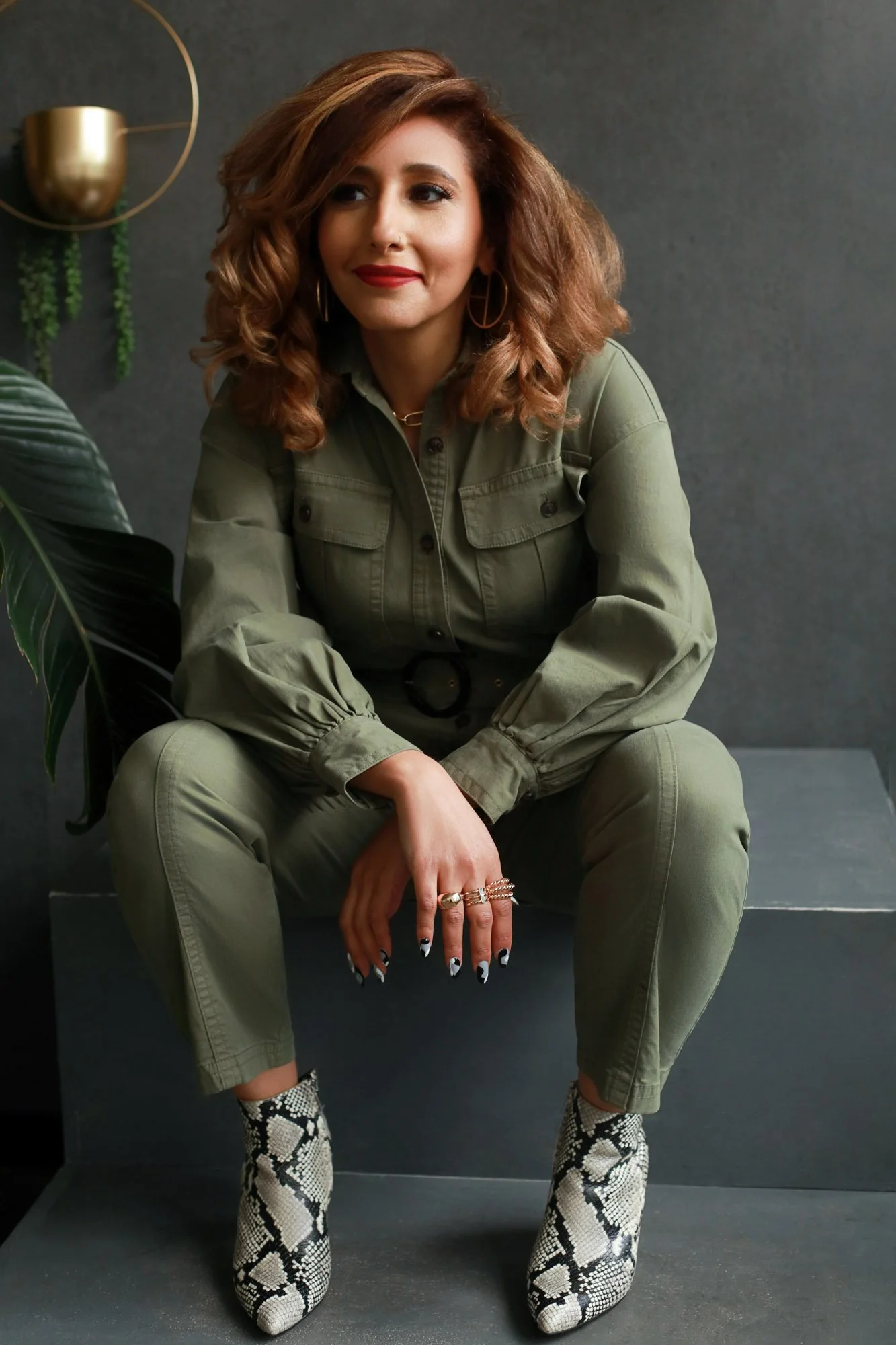
Amenah Arman (she/her)
Art holds what words cannot. Story is how we survive.
And healing, even from the unimaginable, is still possible.
You don't have to translate your pain into something more palatable to receive care here.
Accepting new therapy clients in Maryland for virtual telehealth.
Why I Do This Work
I am a Palestinian Muslim woman, a writer, an artist, a therapist, a mother, and someone who has spent her career sitting with people carrying the kind of grief the world rarely makes room for.
I came to clinical mental health work through community organizing and creative writing, which means I have always understood storytelling as a survival skill. The body holds what the mind cannot always access. Art reaches what language sometimes can't. These are not abstract ideas for me. They are what I have witnessed, in session rooms and in community, with creatives, with founders burning despite their success, with children who lost limbs to war and still found ways to play.
My work with Palestinian and refugee communities, including families and children navigating displacement, loss, and the ongoing reality of genocide, has shaped my clinical lens in ways I carry into every room I enter. The intersection of racial identity, immigration, war, and intergenerational trauma is not a specialty I arrived at from the outside. It is a living part of who I am and what I know.
I am trained in art therapy and expressive arts, narrative exposure therapy, and Gestalt therapy because some experiences are too layered for words alone.
Creativity is not a supplement to clinical care. For many of the people I work with, it is the way in.
I see clients across many areas of life: teens, young adults, and mid-lifers. I am LGBTQ+ affirming and fluent in Arabic and English.
I am here for people who have never quite seen themselves in conventional mental health spaces, and for whom that absence has been its own wound.
My specialty is helping people reconnect with the stories they've been carrying and rebuild from there, using a blend of:
✔ Art therapy and expressive arts as primary healing modalities, not additions.
✔ Narrative exposure therapy for trauma that is collective, intergenerational, or hard to name.
✔ Gestalt therapy for the parts of you that need more than passive conversation.
✔ Culturally grounded care that honors racial identity, faith, immigration, and lived political reality.
✔ Trauma-informed nervous system support that meets the body where it is.
✔ A nontraditional, affirming lens for people who have never fit conventional care.
I believe every person has something worth returning to. My role is to help you find your way back to it.
Professional Overview & Credentials
-
🇺🇸 English, 🇵🇸 Arabic
📌 Other MHC team members speak additional languages. Please inquire if language access is needed.
-
Licensed Graduate Professional Counselor (LGPC) – Maryland
Amenah practices under the clinical supervision of Ateeka Contee, LCPCMS in Clinical Mental Health Counseling – (Georgia State University)
BA in Creative Writing – (Georgia State University)
-
✔ Nationally Certified Counselor (NCC)
✔ Trauma & PTSD
✔ Narrative Exposure Therapy -
✔ Trauma & PTSD
✔ Anxiety & Nervous System Regulation
✔ Women of Color
✔ Art Therapy & Expressive Arts
✔ Narrative Exposure Therapy
✔ Racial Identity & Cultural Trauma
✔ Refugee & Displacement Support
✔ Creatives, Founders & High-Performing Individuals
✔ Muslim Women & Couples
✔ Communities of Color & Culturally Marginalized Identities
✔ Teens Through Mid-life
✔ LGBTQ+ Affirming Care
✔ Grief, Loss & Intergenerational Trauma
✔ Burnout & Chronic Stress -
✅ Offering virtual telehealth sessions & in-office sessions (by invitation only)
✅ In-person locations: Maryland -
📄 Accepted Insurance Plans
Aetna (MD)
Blue Cross, Blue Shield (MD)
Cigna (MD)
Out of Network, Superbills Available (MD)
💳 Self-Pay Therapy Session Fees
Individual: $125
Couples: $180
Group: $50
Sliding scale may be available
✅ Accepted Payment Methods
American Express
Cash
Discover
Health Savings Account (HSA)
Mastercard
Visa
Speaking & Media Opportunities
-
Official Bio
Amenah Arman is a trauma-informed therapist, Nationally Certified Counselor, and licensed clinician at MindFull Healing Collective. A Palestinian Muslim woman, writer, artist, mother, and community organizer, her work integrates art therapy, narrative exposure therapy, and somatic care for people navigating trauma, displacement, racial identity, and the full weight of being human.
She works with teens, adults, and elders across Maryland with deep expertise supporting creatives, refugees, and communities of color. For free resources and to learn more about Amenah, visit MindFullHealingCollective.com
Amenah Arman is a trauma-informed therapist and Nationally Certified Counselor at MindFull Healing Collective. She integrates art therapy, narrative exposure, and somatic care to support creatives, refugees, and communities navigating trauma, racial identity, and displacement across Maryland via telehealth.
Short Casual Bio
Amenah Arman is a therapist, writer, artist, mother, and Palestinian Muslim woman who believes art and story are how we survive. She brings her full self into the room and makes space for yours
-
Racial Identity Is Not a Presenting Problem
Culturally Grounded Care for Communities Conventional Therapy Has Failed
Many people of color, immigrants, and Muslims have learned not to expect to see themselves in mental health spaces. The absence is not accidental. It is the result of systems that were not built for them and have rarely been honest about that.
Amenah draws from years of work with communities for whom cultural identity, faith, immigration status, and racial experience are inseparable from clinical presentation. She explores what culturally grounded care actually requires, beyond cultural competency checklists, and what it means to build a practice where people do not have to leave parts of themselves at the door.
Learning ObjectivesUnderstand how systemic exclusion from mental health care shapes help-seeking behavior and clinical mistrust
Identify the difference between cultural competency as a credential and cultural humility as a practice
Recognize how racial identity, faith, and immigration intersect with trauma, grief, and anxiety
Learn how narrative and expressive approaches create access for clients who have been failed by traditional modalities
When the Body Carries What History Won't Name
Art, Trauma, and the Healing Power of Creative ExpressionTrauma stored in the nervous system does not always respond to words. For people navigating war, displacement, racial violence, and intergenerational loss, creative expression is not supplemental to healing. It is often where healing becomes possible at all.
In this talk, Amenah draws from her clinical work using art therapy and expressive arts with refugees, children, communities of color, and others whose experiences exceed what language alone can hold. She explores why creativity is a clinical modality, not a coping strategy, and what it means to build treatment around the whole person.
Learning ObjectivesUnderstand why expressive arts and art therapy are evidence-informed, not supplemental, approaches to trauma treatment
Recognize the limits of talk-based therapy for trauma rooted in collective and embodied experience
Identify how creative modalities support nervous system regulation and meaning-making
Learn how to create clinical and community spaces where creativity is centered, not added on
Witnessing Genocide and Still Doing the Work
Mental Health, Moral Injury, and the Therapist Who Is Also Living This
What does it mean to be a Palestinian Muslim therapist holding space for others while also living through a genocide? What does it ask of a clinician to stay regulated, present, and boundaried when the crisis is also personal?
In this talk, Amenah speaks from her own experience as a practitioner whose community and family are directly impacted by the ongoing genocide in Palestine. She addresses moral injury in the therapy room, the weight of vicarious and direct trauma, and what it looks like to build a sustainable, values-aligned practice when the world is on fire. This talk is for therapists, healers, social workers, and coaches navigating their own relationship to collective grief and political trauma while continuing to serve.
Learning ObjectivesUnderstand moral injury as distinct from burnout and how it shows up in helping professionals
Recognize the particular weight carried by therapists whose communities are in active crisis
Identify sustainable practices for staying grounded without compartmentalizing lived reality
Reframe practitioner self-disclosure and identity as clinical assets, not liabilities
-
[coming soon]
-
Please email our visibility strategist, India Tizol, at: itizol@mindfullhealingcollective.com
